
This article traces the evolution of Luxury Vinyl Plank (LVP) flooring from its introduction in the late 1970s to modern variants like WPC (Waterproof Polymer Core) and SPC (Stone Polymer Core) products. Written by Tim McAdoo, a 43-year industry veteran, the piece examines how installation methods, adhesive technologies, and product structures have transformed dramatically, and why understanding these changes is critical to avoiding costly failures.
The central theme: LVP resilient floorings has evolved rapidly over the past 2 decades, but many installers and end-users fail to follow proper installation according to product specifications, leading to widespread performance issues.
Historical Timeline of LVP Evolution
LVP resilient floorings has emerged as a revolutionary alternative to traditional hardwood, offering plank aesthetics without solid wood costs. The technology has undergone three major transformation phases:
| Era | Installation Method | Core Structure | Key Limitation |
|---|---|---|---|
| Late 1970s–Early 2000s | Wet set (glue-down) with hard-set or epoxy adhesives | Solid vinyl | Dimensional instability; adhesive quality critical |
| 2000s–2010s | Floating with tape systems; then locking systems | Vinyl with foam backing | Sunlight sensitivity; moisture concerns |
| 2010s–Present | Floating or glue-down with locking systems | WPC, then SPC with attached foam/cork pad | Extreme density; brittleness in cold; sunlight resistance improved |
Installation Methods: From Wet Set to Floating
The Critical Bond Strength Principle
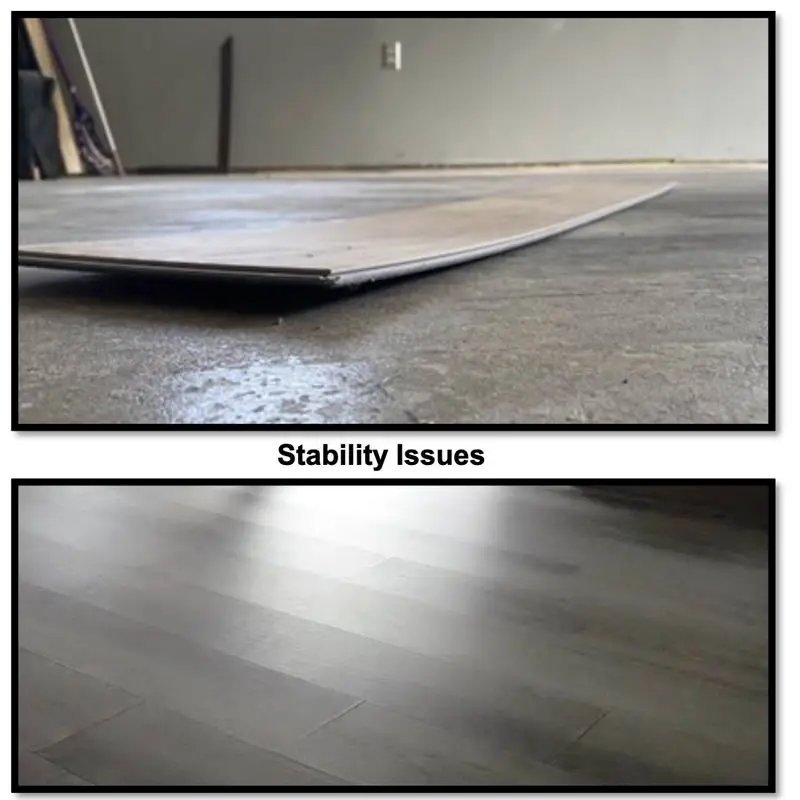
The foundational issue with LVP adhesion is that adhesive selection alone cannot fix dimensional instability in the flooring product itself. When LVP planks arrive warped or unstable from the factory, no adhesive, whether its cheap or more expensive LVP products, will ever correct this. This is a non-negotiable rule installers often violate. When it is found that LVP planks are already deformed, installers needs to immediately return the products to where they purchase the LVP from for immediate warranty supports.
Wet Set vs. Pressure Sensitive Adhesives
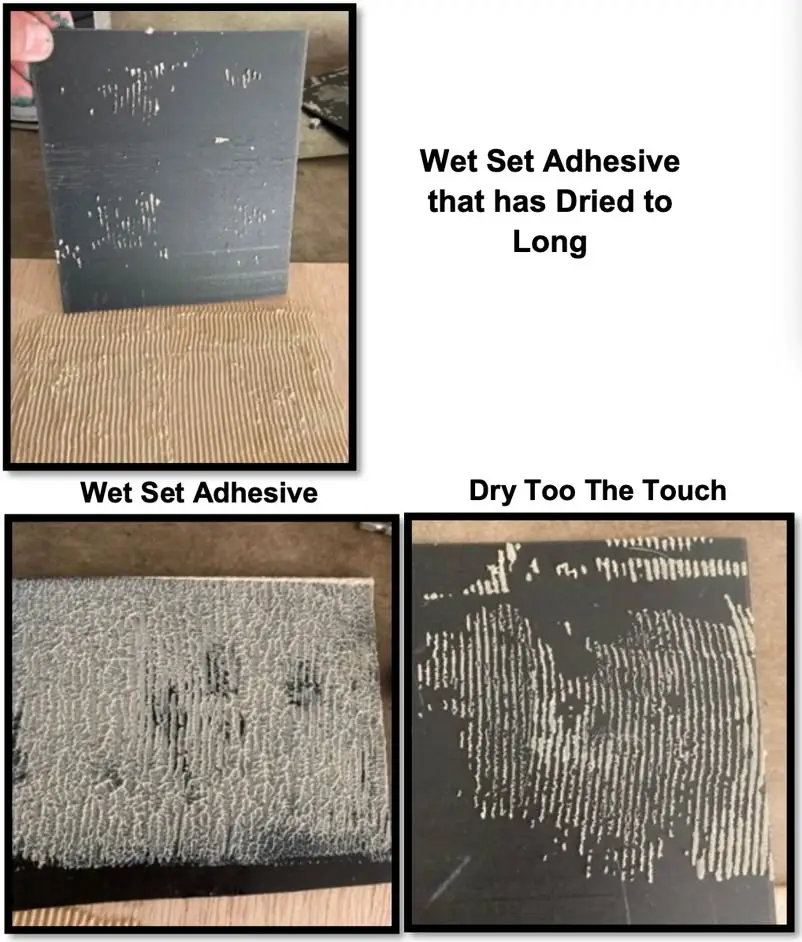
Wet Set Adhesive (Historical Standard):
When adhesive is applied and flooring is placed while wet, the adhesive flows beneath the plank, achieving approximately 95% coverage of the plank back. This creates maximum bond strength.
Pressure Sensitive Adhesive (Modern Standard):
When allowed to dry to touch, coverage drops to approximately 60% of the plank back, creating minimal bond. This method dominated modern LVP installation because of speed, but it sacrifices holding power.
The Resurgence of Wet Set:
New adhesive formulations now can handle extreme conditions. With example for 100% relative humidity on concrete, direct sunlight, and dimensional instability conditions, but they require wet set installation and not dry-to-touch application. These adhesives are not pressure-sensitive; they have zero tack once dry and will fail if installers apply them like traditional pressure-sensitive products.
Key Installation Warning
Installers must follow manufacturer instructions precisely. Many now expect wet set installation similar to hardwood: trowel 2–3 feet of adhesive, wet set the LVP, tape joints, roll with a 100-lb. roller, and wipe excess. Shortcuts will potentially result in adhesion failure and product movement.
Core Product Structures and Limitations
WPC (Waterproof Polymer Core)
An evolution and perhaps upgrade to basic vinyl, WPC provide a wood-like echo performance from its foaming core. However, it retains vinyl’s weakness and sunlight exposure can still causes expansion and distortion. Manufacturers recommend drapes or blinds during peak sunlight exposure, a critical detail often overlooked by end-users who believe the product is UV-proof.
The term waterproof is misleading. The WPC composition itself is resist to water penetration but may curl or cup when exposed to moisture, and warranty coverage does not extend to these cosmetic deformations.
SPC (Solid/Stone Polymer Core)
SPC replaces vinyl with limestone and claims sunlight and temperature immunity. This allows installation in enclosed 3-season rooms, a major selling point for SPC flooring. However, SPC has distinct challenges:
- Installation temperature sensitivity: Must install at 55°–85°F (or 70°F average). Products become brittle below this range.
- Density: The hardness makes cutting more difficult and prevents flexing over uneven subfloors.
- Attached underlayment: Most SPC products comes with 1.0 to 1.5mm foam or cork padding. When installing SPC with pre-attached pad, it is not recommended to add additional underlayment, as this increases deflection and can voids warranty.
- Glue-down option risk: Some locking SPC/WPC products offer glue-down installation. This is risky because adhesive may not bond properly to attached foam pads, and shear forces or moisture can compromise the weak bond.
Locking Systems: Compatibility and Installation Precision
Modern floating LVP relies on mechanical locks rather than adhesive. Four main systems exist, each with different installation requirements:
| Locking System | Long-Side Lock | Short-Side Lock | Common Use |
|---|---|---|---|
| Unilin | Angle/Angle | Angle/Angle | Laminate, floating hardwood, LVP |
| Välinge 2G | Angle/Angle | Angle/Angle | Laminate, floating hardwood |
| Välinge 5G | Traditional angle | Flexible plastic tongue snaps into wedge | LVP/WPC |
| I4F Drop & Tap | Traditional angle | Tapped with rubber mallet | LVP (new; causes installer confusion) |
Critical point: These locks are thin and rigid—they cannot flex or bend over uneven subfloors without breaking. Incorrect installation can damages the lock, causing joints to fail and open.
Subfloor Requirements and Expansion Zones
Flatness Standards
Despite marketing claims that floating LVP can go “almost anywhere,” brands’ installation instructions specify rigid requirements:
- Subfloor must be clean, dry, and smooth
- Flatness: Within 1/4 inch (or 3/16 inch per some specs) in a 10-foot span
- No bumps or low spots
- Slope: No more than 1 inch per 6 feet
As the old saying goes: “You go over crap; you’re going to have scrap.”
Expansion Zone Limitations
Floating floors require expansion breaks, especially in spaces with hallways and multiple doorways. Flooring brands often suggest large maximum coverage (up to 6,000 sq. ft.), but this assumes a single rectangular room. Pinched sections cause cascading failures across large areas. Multi-purpose trim pieces in doorways are essential to allow independent floor movement.
Underlayment Compatibility and Pitfalls
Material Chemistry Reactions
PVC + SBR Crumb Rubber = Failure
Crumb rubber or recycled rubber underlayments are incompatible with vinyl flooring. The chemistry reaction between PVC (polyvinyl chloride) in vinyl and SBR (styrene-butadiene rubber) in underlayment causes:
- Vinyl distortion
- Plasticiser migration
- Delamination and buckling
Black Vinyl Foam Underlayments:
These use carbon pigment for colour, which prevents adhesive adhesion. Adhesive can “disappear” from these surfaces, leaving bubbles and buckling when moisture rises from the subfloor.
When NOT to Use Underlayments
- Never add underlayment to SPC/WPC with attached padding (voids warranty)
- Avoid in areas with rolling loads (indentation risk)
- Do not assume underlayment masks a bad subfloor – it cannot
Environmental Stressors
Moisture
Even “waterproof” products have strict moisture limits. High subfloor moisture causes:
- Adhesion failure
- Buckling and cupping
- Delamination, especially with incompatible underlayments
New wet-set adhesives tolerate up to 100% relative humidity, a major advancement in LVP resilient floorings.
Sunlight
Vinyl expands under direct sunlight, causing:
- Physical distortion and buckling
- Failure when combined with insufficient expansion zones
SPC claims to resist sunlight, but even SPC can fail if the underlayment lacks stability.
Temperature
Installation must occur at 55°–85°F. Installing SPC in cold conditions produces brittle material prone to breaking during handling and locking.
PVC-Free Flooring: Emerging Complexity
A new category eliminates PVC entirely, requiring acrylic wet-set adhesives. These adhesives have virtually no working time once dry to touch, demanding strict adherence to instructions.
Critical concern: PVC-free LVP resilient floorings can react with residual plasticizer from previous vinyl installations and abatement chemicals. Thorough floor prep is non-negotiable and residuals should always have been removed before renovation and installation.
Key Takeaways for Flooring Success
- Adhesive quality reflects installation method, not product stability. Weak adhesives cannot fix unstable planks.
- Wet-set installation is returning for high-performance applications. Master this technique.
- Subfloor standards are non-negotiable. Flatness, dryness, and smoothness determine success.
- Underlayment chemistry matters. PVC + crumb rubber fails predictably; black foam prevents adhesion.
- Expansion zones prevent cascading failures. Honor them even in large spaces.
- Locking systems require precision. Misaligned installation breaks locks irreversibly.
- Environmental conditions during and after installation are critical. Temperature, moisture, and sunlight exposure cause most field failures.
The Flooring Industry Reality
The explosive growth of LVP has flooded the market with low-cost products that fail to meet expectations. Problems are epidemic because low price points correlate with quality shortcuts. Following brands’ specifications rigorously remains the only reliable path to avoiding costly failures and warranty disputes.